

Whatsapp button
Podcasts

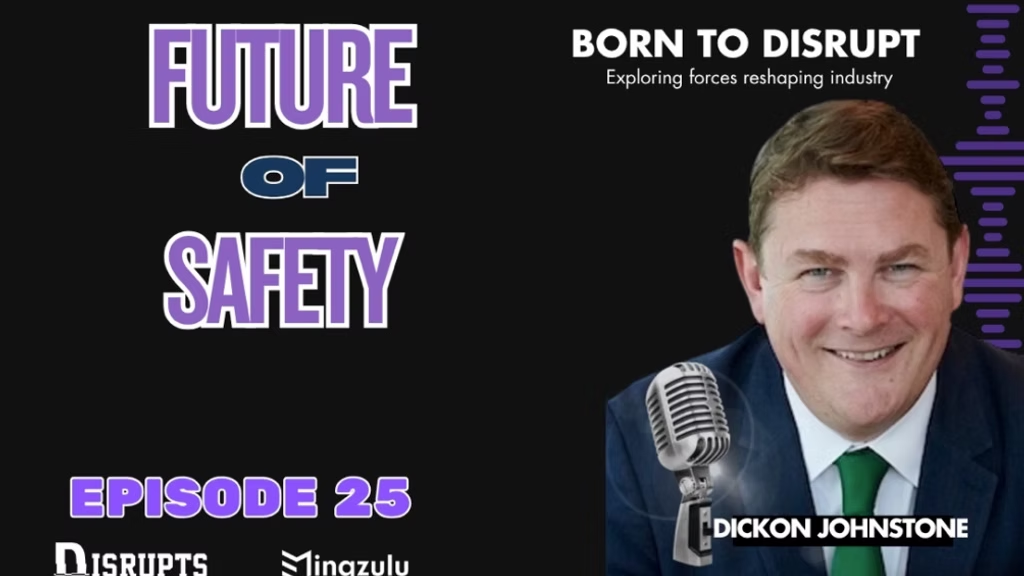
Navigating Risk and Disruption in Geopolitical Turmoil with Dickon Johnstone

After a pause due to the USA, Israel & Iran conflict here in the Middle East, Born to Disrupt is back in action! Our latest guest and topic are perfectly aligned with current times!
post-01post-01-mobile
Jump to
01
Introduction

When Geopolitics Moves Faster Than Strategy

In today’s operating environment, risk is no longer static—and neither is opportunity! In this episode of Born To Disrupt, Grant Niven hosts Dickon Johnstone, CEO and founder of Themis, for a timely and highly relevant discussion on how businesses must evolve in response to rapidly shifting geopolitical tensions, particularly across the Middle East.

The headline insight is simple but powerful: Most organisations are underestimating how quickly the threat landscape is evolving and overestimating their ability to keep up using legacy approaches.

1. The New Reality: Risk is Real-Time

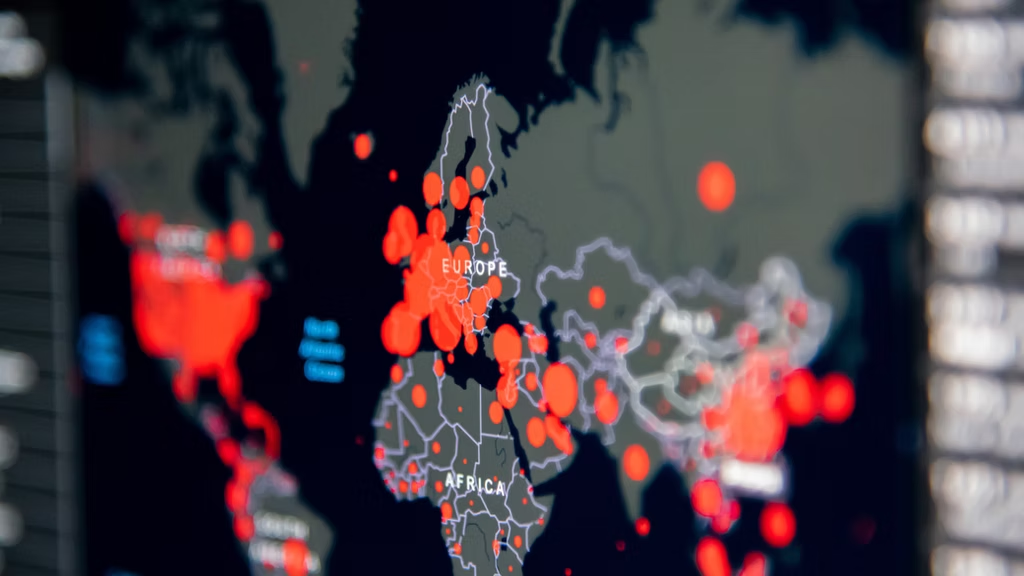
Geopolitical conflict is no longer a distant macro factor; it is directly shaping:

  • Capital flows
  • Supply chains
  • Regulatory enforcement
  • Counterparty risk

As Dickon outlines, the speed of change is unprecedented! Sanctions lists evolve daily, enforcement expectations tighten, and previously “low-risk” counterparties can quickly become high-risk exposures.

The implication: Static compliance frameworks are fundamentally misaligned with a dynamic world. Leading organisations are shifting toward real-time, intelligence-led risk management—where decisions are informed continuously, not periodically.

2. AI is Rewriting the Rules of Financial Crime Prevention

One of the most compelling themes from the discussion is the transformational role of AI in compliance and risk management. Historically, financial crime prevention has relied on:

  • Manual due diligence
  • Rule-based monitoring systems
  • Fragmented data sources

Today, AI is enabling a step-change:

  • Pattern recognition across vast, unstructured datasets
  • Early detection of emerging risks
  • Automation of complex due diligence processes

For firms operating in high-risk environments, this is not just an incremental improvement; it is a fundamental shift in capability.

‍Dickon’s perspective: AI is not just increasing efficiency; it is enabling organisations to see risks that were previously invisible!

3. Democratising Due Diligence: From Large Institutions to Every Business

A standout insight from Themis’s approach is the democratisation of due diligence. Traditionally, only large financial institutions had the resources to conduct deep, multi-layered investigations into:

  • Counterparties
  • Supply chains
  • Beneficial ownership structures

AI-powered platforms are changing that. Now, businesses of all sizes—from fintech startups to mid-market corporates—can access:

  • Advanced risk intelligence
  • Automated screening tools
  • Continuous monitoring capabilities

Why this matters: In volatile regions like the GCC, smaller firms are often the most exposed and historically the least equipped. This shift levels the playing field!

4. The Middle East: High Growth Meets High Scrutiny

The Middle East continues to position itself as a global hub for:

  • Investment
  • Innovation
  • Digital transformation

But with that growth comes heightened scrutiny! Dickon highlights how regulators and institutions across the region—particularly in the UAE and Saudi Arabia—are:

  • Increasing expectations around compliance and transparency
  • Investing heavily in AI-driven regulatory frameworks
  • Aligning with global standards on financial crime prevention

What we’re seeing: A rapid acceleration in AI adoption for compliance across the GCC. For businesses, this creates a dual imperative:

  1. Keep pace with regulatory expectations
  2. Leverage the same technologies to stay competitive

5. Sanctions, Dual-Use Goods & the Complexity of Modern Trade

A particularly nuanced part of the discussion focuses on dual-use goods, products that can serve both civilian and military purposes. In periods of geopolitical tension, these become a critical area of scrutiny. AI is now being deployed to:

  • Identify high-risk trade flows
  • Detect anomalies in supply chains
  • Flag potential sanctions violations

The challenge: These risks are often deeply embedded and difficult to detect using traditional methods.

The opportunity: AI enables a level of visibility and precision that was previously unattainable!

6. The Future: Automated, Conversational, and Continuous Risk Intelligence

Looking ahead, the future of compliance is not just automated; it’s interactive and embedded into decision-making. Dickon outlines a shift toward:

  • Conversational AI interfaces for risk analysis
  • Fully automated due diligence workflows
  • Continuous monitoring across global operations

Imagine a world where:

  • A CEO can query risk exposure in real time
  • A compliance team can instantly assess a new market entry
  • A deal team can evaluate counterparties during live negotiations

This is no longer theoretical—it’s already emerging!
7. Practical Advice for Leaders in Volatile Markets

For CEOs, founders, and policymakers navigating today’s environment, the conversation offers clear, actionable guidance:

1. Treat Risk as a Strategic Function

Move beyond compliance as a checkbox exercise! Embed it into core decision-making.

2. Invest Early in AI Capabilities

The gap between AI-enabled and non-enabled organisations is widening rapidly.

3. Build for Agility, Not Stability

Structures, systems, and teams must be able to adapt quickly to changing conditions.

4. Understand Your Exposure—Deeply

From supply chains to counterparties, visibility is everything!

5. Engage Proactively with Regulation

In regions like the GCC, regulators are evolving fast—engagement is a competitive advantage!

Closing Perspective: Turning Disruption Into Advantage

This episode of Born To Disrupt reinforces a defining theme of the series: Disruption is not just a threat—it is a filter. We're onto a new theme via this episode - "The Future of Safety."

It separates:

  • Reactive organisations from proactive ones
  • Static strategies from adaptive models
  • Those who survive from those who lead

As Dickon articulates, the organisations that will define the next decade are those that can:

  • Harness AI effectively
  • Translate geopolitical complexity into actionable insight
  • Build resilience without sacrificing growth

For the Born To Disrupt Community

If you are operating in or entering high-growth, high-risk markets—particularly across the Middle East—this conversation is essential. It offers not just perspective but a playbook for navigating uncertainty with confidence.
Join the Conversation

  • How is your organisation adapting to geopolitical risk?
  • Are you leveraging AI in compliance—or falling behind?
  • Where do you see the biggest opportunities emerging from disruption?

Related article

MingZulu Unveils New Brand as the Firm Enters Its Next Phase of Growth
September 21, 2026
10 min read

MingZulu Unveils New Brand as the Firm Enters Its Next Phase of Growth

Dubai, United Arab Emirates. MingZulu, an international advisory and growth firm headquartered in the UAE, today unveils its new brand. A milestone that signals a sharpened sense of purpose and a bolder declaration of how the firm operates.
Read more
Articles
Innovating Insurance: AI, Transformation and the Future of Customer Trust with Lars Gehrmann.
June 30, 2026
10 min read

Innovating Insurance: AI, Transformation and the Future of Customer Trust with Lars Gehrmann.

The insurance industry is entering one of the most significant periods of transformation in its history.
Read more
Podcasts
The New Technology Battleground: AI, Resilience and Sovereignty in the Middle East.
June 30, 2026
10 min read

The New Technology Battleground: AI, Resilience and Sovereignty in the Middle East.

In this episode of Born To Disrupt, hosts Simon Hardie and Grant Niven are joined by seasoned technology executive Mark Diamond, CIO and former CTO and COO across global banking, payments and financial services organisations.
Read more
Podcasts
Newsletter

Coming Soon

Close-up of overlapping orange feathers with soft texture and fine details.
Close-up of vibrant orange and pink bird feathers showing detailed texture.